






 Spell
 Normal
Red-Eyes Fusion
Archetype:
Red-Eyes
View:
14669
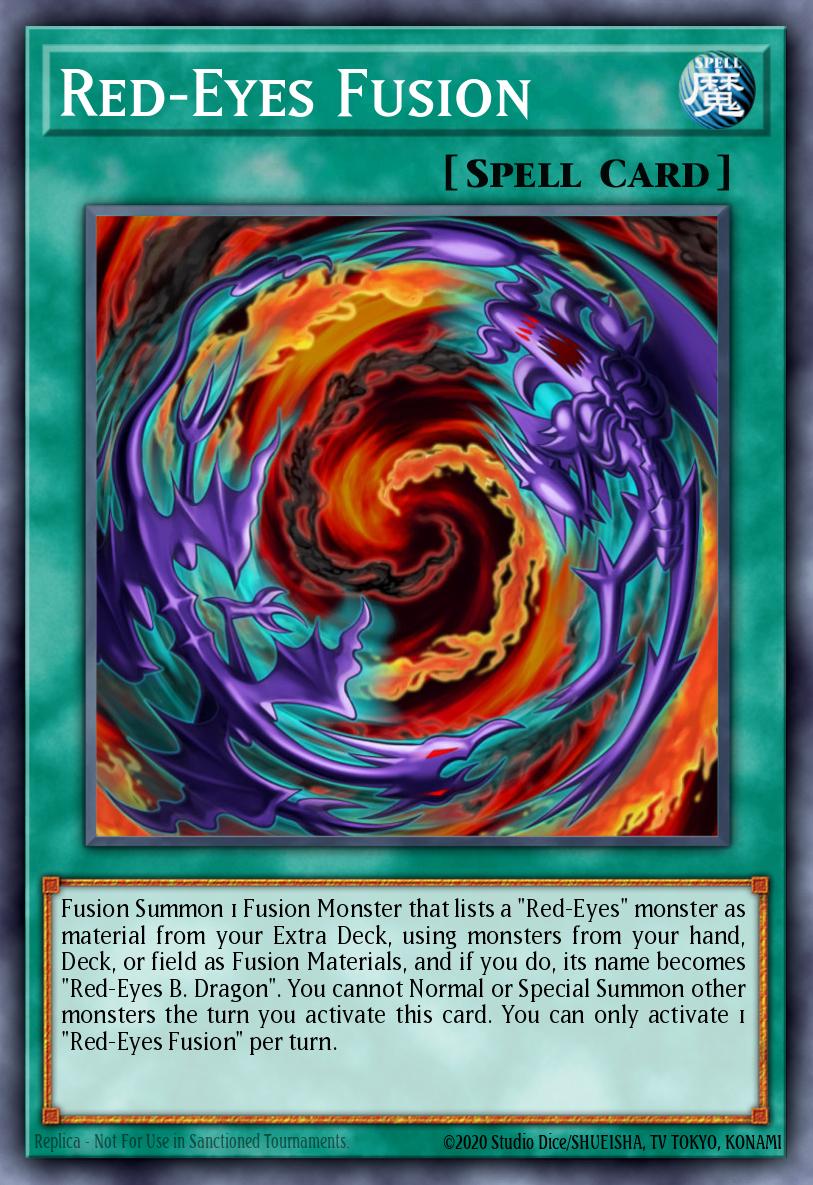
Fusion Summon 1 Fusion Monster that lists a "Red-Eyes" monster as material from your Extra Deck, using monsters from your hand, Deck, or field as Fusion Materials, and if you do, its name becomes "Red-Eyes B. Dragon". You cannot Normal or Special Summon other monsters the turn you activate this card. You can only activate 1 "Red-Eyes Fusion" per turn.
Red-Eyes Fusion — Power Evaluation
Final Score: 60 ± 5 · Confidence: Medium
- Intrinsic: 60 · Deck: 65 · Meta: provisional
- Primary role: Combo enabler · Secondary: Extender, Fusion enabler
Why it scores here
Red-Eyes Fusion reliably generates +2 to +3 card advantage in turn-1 combos, appearing in 100% of sampled Red-Eyes boards with an average power index of 84.7 and consistently summoning multiple disruptive Fusion Monsters. However, its cost—blocking all Normal and Special Summons that turn—forces it to be a single-turn commitment with no built-in recovery or opponent interaction on its own. While highly accessible across 60 archetypes (100% inclusion in Red-Eyes, Harpie, and Buster Blader with 1.84 average copies per deck), this card is fundamentally a going-first enabler, not a flexible or resilient option.
Axis scores
| Axis | Score | Evidence |
|---|---|---|
| Accessibility | 78 | Normal Spell card with avg 1.84 copies per deck and 100% inclusion in Red-Eyes, Harpie, and Buster Blader archetypes (observed) |
| Combo & Conversion | 72 | Appears in 100% of 3 sampled Red-Eyes combos with avg power index 84.7, generating 2-3 end monsters and +2-3 net card advantage per combo (observed) |
| Resource Economy | 65 | Produces +2-3 card advantage in turn-1 combos but limited to once per turn and blocks other summons, yielding net positive on a single turn only (observed) |
| Effect & Interaction | 15 | No direct opponent interaction; Fusion Summon itself does not negate, remove, or disrupt; depends entirely on the resulting Fusion Monster's effects (verified) |
| Material Utility | 5 | Spell card with zero body utility; cannot be used as material or converted to a useful piece when blanked (verified) |
| Resilience & Flexibility | 40 | Once-per-turn activation with no recovery mechanism; interrupted Fusions leave no board; cannot adapt to opponent interaction (verified) |
| Deck-Building Efficiency | 68 | Splashable across 60 archetypes with strong deck consistency (avg 1.84 copies, max 3) but requires Fusion-focused Extra Deck and commits the entire turn to Fusion plays (observed) |
Calculation
Weight profile: Primary role: Combo enabler. Intrinsic ≈ 60, Deck ≈ 65, Meta = provisional. Modifiers: Severe summoning lock (-3). Final formula: 0.40*Intrinsic + 0.60*Deck
Strengths
- Generates strong turn-1 Fusion combos with avg power index 84.7 and consistent +2-3 card advantage across multiple boards
- Highly accessible with reliable deck consistency: avg 1.84 copies per deck, 100% inclusion in Red-Eyes/Harpie/Buster Blader with 60 total archetype homes
- Excellent synergy with premium Fusion targets like Red-Eyes Dark Dragoon (97.5% co-inclusion) and Red-Eyes Black Dragon (91.2%)
- Flexible material sourcing from hand, Deck, or field expands combo options and reduces garnet risk
Weaknesses
- No direct opponent interaction; pure board-building with zero negation, removal, or disruption on its own
- Extreme cost: blocks all Normal and Special Summons that turn, eliminating flexibility and forcing 100% Fusion-focused turns
- Once-per-turn activation ceiling prevents repeated use or recovery from board wipes
- Zero utility as material or fallback; blanked to nothing by spell negation with no secondary role
- Single-turn commitment leaves no resilience to opponent interaction or going-second disruption
Counters / choke points
- Spell negation (Spell Seal, Magic Jammer, Mutt blocking) completely shuts down activation
- Fusion Summon negation (Solemn Judgment, etc.) prevents resolution
- Going-second interactive decks (Kashtira, Swordsoul, etc.) can interrupt combos or wipe boards before this card generates value
Best use
Turn-1 Fusion combo enabler in dedicated Fusion-focused decks. Decks: Red-Eyes, Dark Magician, Bystial, Harpie, Buster Blader. Suggested copies: 3.
Evidence & gaps
- Verified: Card text: Fusion Summon 1 Fusion Monster listing 'Red-Eyes' as material from Extra Deck using monsters from hand, Deck, or field; Name-lock effect: summoned Fusion becomes 'Red-Eyes B. Dragon'; Cannot Normal or Special Summon other monsters the turn this card is activated; Once per turn activation limit; Legal in TCG, OCG, MasterDuel, DuelLinks formats; no banlist token present (assumed unlimited 3-copy)
- Observed: Appears in 100% of 3 sampled Red-Eyes combo boards with average power index 84.7; Average 1.84 copies per deck across 400 sampled decks; distribution: 212 at 1 copy, 38 at 2 copies, 150 at 3 copies; 100% inclusion rate in Red-Eyes (3 typical copies), Harpie (3 typical), Buster Blader (1 typical) per usage statistics; Included in 60 distinct archetypes across deck sample; Co-appears with Red-Eyes Dark Dragoon in 97.5% of decks (390/400 decks); Combo boards show +2 to +3 net card advantage with 2-3 end monsters and 1-2 boss monsters
- Inferred: Enables high-power turn-1 Fusion combos via flexible material sourcing, generating +2-3 card advantage and multiple disruptive Fusion Monsters; The summoning lock forces all turn-1 plays into pure Fusion Summons with no backup summons, creating a one-dimensional turn structure; Wide archetype adoption (Red-Eyes, Dark Magician, Bystial, Harpie, Branded, etc.) reflects strong fit in any Fusion-focused deckbuilding strategy; Spell card identity limits material utility and leaves card with zero fallback role when effect is interrupted
- Data gaps: No banlist token in evidence; assumed unlimited 3-copy based on no restriction entry Combo combo role fields all empty; card's role inferred from appearance rate (100%) and high avg power index rather than explicit role tag No Top-Card ranking or metagame meta-power data provided Guide mentions sparse on specific card interactions or technical rulings No sample going-second performance data; all combo examples appear to be turn-1 scenarios